





|
MakeLinks for Opera
  |
Manual Usage:
Highlight any section of text that contains a web address to trigger the popup. The popup is dismissed by clicking anywhere outside the popup.
Detected links
Below is a selection that shows the currently detectable links.
Normal protocols
http://www.example.com
https://www.example.com
ftp://www.example.com
ftps://www.example.com
Normal links and unwanted punctuation spit using breadcrumbs
http://www.example.com/path/
http://www.example.com/path/page.html
http://www.example.com.
http://www.example.com/path/.
http://www.example.com/path/page.html.
http://www.example.com/path/).
Non-ftp/non-http or missing protocols (detected if settings are changed)
hxxp://www.example.com/path/page.html
hxxp://www.example.com/path/page.html.
www.example.com/path/
www.example.com/path/.
www.example.com/path/page.html
www.example.com/path/page.html.
Published
I've published updates to both the Opera 12 and the Opera 15 extension versions. It should be available soon. The major feature is that link detection has been improved.
The update should be available in a day.
An Update
I'm in the process of updating the extension to work in the new Opera 15 with Webkit. It will be published on the Opera site soon.
A Temporary Home
I uploaded version 1.1.0 to the Extension Catalog three days ago, but the new Opera version must have dramatically slowed down their approval process. Until it's updated there, you can find the final version in the Public Beta uploads HERE.
The Next Version
MakeLinks will be moving from version 1.0.5 to 1.1.0. The method for automatically inserting icons/links and the method for selecting nodes has been replaced with a streamlined and safer process. This, also, now means the overhead for parsing very large documents should be minimal.
Finally Found
I finally found a safer method for injecting links and icons. This means icons and links will be in the proper place and won't require an option. Since this is a major change, I will be testing this for a few days before uploading it as an official update.
More Current Status
I was able to add the options (listed in the previous post) to the current beta version (1.0.4) of MakeLinks. Also included is the requested option to use clickable links instead of clickable icons. What I don't like about this option is that you can't tell when the link is part of the page or added by the extension. If something breaks, it will be hard for a user to detect the difference between a broken page and a conflict created by the extension.
As before, there's a warning when using this new option since it may cause a conflict on the target page. When operating in the "next to addresses" mode, the target page code is inserted in the middle of the existing code. When not, the code is virtually moved after the element containing the link. It will not split important code, but it also may appear further than expected from the link. The good news is that causing a conflict is rare, so it's really less of an issue than expected. The 'Excluded Websites' list is also another safety feature that makes any conflicts even less of an issue.
If no problems are found in the next few days, the current Test 3 version will be released as an official version.
Current Status
Version 1.0.2 is out but version 1.0.3 already waiting for publishing. Version 1.0.3 is a quick-fix for the 'automatic' configuration option being broken and for the icon being manipulated by the target pages style sheet.
I'm working on a new version (1.0.4) currently with a small set of goals. I'm working to further improve the link detection process. This will allow me to support the automatic detection of links in the form of www.example.org without requiring a path after the hostname.
I've had two feature requests. The first is an option to disable the popup. Since MakeLinks can work in automatic mode, this makes sense. The second is an option disable the plugin for specific sites. I'm not a fan of this second option because I'd rather just fix the extension so that it doesn't conflict with other sites, but this might not be a practical possibility. There will always be a period of time between the conflict and me being able to fix it or work around the conflict. A stopgap solution seems to be needed.
A Compromise Part 2
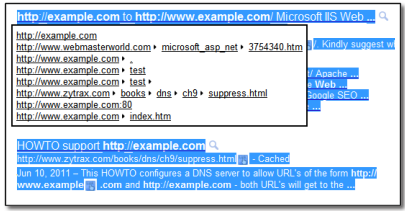
I was able to re-add dirty link detection for the automatic mode in the last Public Beta upload. To test this, search for 'http://www.example.org' on Google where search terms are often places in bold text. The highlight method for detecting links already has this feature since it can detect the highlighted text without any formatting.
In the last upload, I think I've made the 'next to addresses' option very stable and fast. While it's still possible for it to corrupt code, since it actually changes the page, I've seen very few problems besides some minor layout changes. Without this option, the icon links are actually appended code - which means their placement can be further away the expected location.
Unless any further problems are found, v1.0.2 Test 4 will be the officially released version.
A Compromise
The newest upload (Test 4), is a compromise to improve speed, compatibility, and functionality. The previous test interfered with the normal operation of some pages, especially complex web pages. The 'next to address' option was rewritten to prevent this situation.
This changes mean that detecting 'dirty' links will have to be implemented some other way, but it is possible to do using the new method. This will likely be re-added in the next test version.
Finally, automatic detection is now triggered sooner. The extension is triggered to execute before some non-essential items, like images, are finished downloading. Pages with a large number of these items to download would stall the execution of this function.